

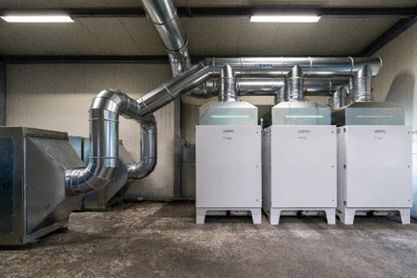
An integrated environmental sanitization system that exploits a set of IoT sensors distributed within the plant to constantly monitor air quality parameters and thus define the pollution level of the entire production site. That is a summary of the goal that guided Losma through the past three years of research and development dedicated to the Green Factory System, which was made possible through co-financing by the EU life Program for reducing the effects of climate change and improving air quality within and outside industrial environments.The research focused on reducing CO2, levels, eliminating spores, moulds, odours, carcinogenic substances, viral charges and bacteria in the air during the various processing cycles. Integration with IoT sensors and development of predictive models have ensured greater plant efficiency, high energy savings and fully predictive automated maintenance. The Green Factory System can be adapted to suit the processing plant surface area and is made up of a number of treatment stages.
Based on know-how gained over 50 years of activity, Losma provides the market with an efficient consultancy and engineering service that is organized to support the customer from design up to installation of the turnkey centralized plant. From sizing the conventional filtration unit to designing the aeraulic plant (with fixed and mobile collection points and possibly a centrifugal fan), the Losma Green Factory System combines the best of research into purification of oil mists, vapours and fumes from a wide range of mechanical processes. It is ideal for large centralized plants that need to process several cubic meters of air per hour.Argos Pro range is specially designed to filter oil mists (emulsions or neat oil), vapours and fumes from various mechanical machining processes. The filter module is a unit specifically designed for the industrial sector, where robustness, reliability and ease of operation and maintenance are key features. It is available in seven different construction models with flow rates from 3,000 to 15,000 m3/h and various combinations of increasing filtration efficiency, up to 99.95% (according to EN 1822). The programmable plant control interface can be used to remotely manage the various intake areas spread throughout the plant. The control interface features plant self-calibration based on air reporting data, and is an additional tool that allows the end-user to track system warnings and alerts, as well as, of course, remotely manage preventive and predictive plant maintenance